The 10 Life Roles: Why Your Chinese Zodiac Sign Can't Predict Your Career (And What Actually Does)
Published on July 2, 2026•8 min read
The Illusion of the Zodiac Animal
If you have ever read a Chinese Zodiac horoscope for your birth year and thought, "This sounds absolutely nothing like me," you are not alone.
For years, the Western world has been obsessed with the 12 Chinese Zodiac animals. People read about being a "wood dragon" or a "fire snake" and try to extrapolate their entire personality, career trajectory, and relationship compatibility from that single data point.
As a developer who spends his days building systems and mapping complex logic, I can tell you exactly why this fails: Your Zodiac animal only represents the year you were born, which accounts for roughly 12.5% of your total energetic architecture. It’s like knowing the make of a car, but having zero information about the engine, the transmission, or the software running it. It cannot accurately tell you what kind of career you will thrive in, or what kind of partner you will attract.
What truly blows people's minds isn't their animal sign. It’s an ancient subsystem in Chinese Metaphysics (BaZi) known as the "Ten Gods".
The 10 Life Roles
Don't let the translated name "Ten Gods" fool you—they aren't actual deities you pray to. Think of them as 10 internal archetypes or "Life Roles" that dictate exactly how you interact with the world, process information, and generate value.
From a systemic perspective, these roles are mathematical outputs. They are calculated based on how the Five Elements (Wood, Fire, Earth, Metal, Water) in your broader chart interact with your Day Master (your core self).
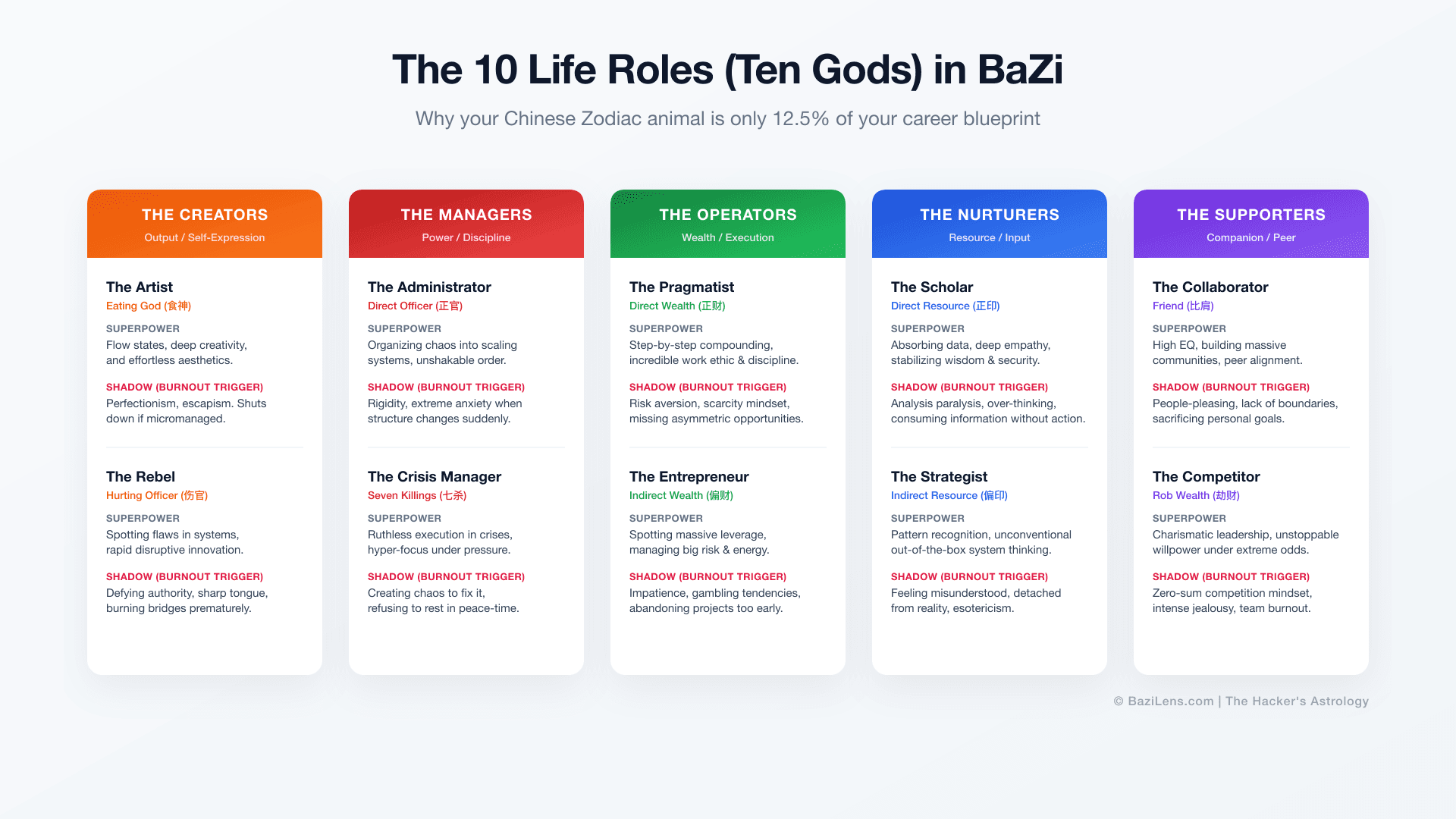
Everyone has a unique mix of these 10 roles, but your dominant ones act as your core psychological blueprint. We can group them into five major functional categories:
1. The Creators (Output)
- ●The Artist (Eating God): Driven by pure self-expression, aesthetics, and deep flow states.
- ●Superpower: Effortless creativity and producing high-quality work when left alone.
- ●The Shadow: Prone to perfectionism and escapism. If rushed or micromanaged, your creative energy shuts down completely.
- ●The Rebel (Hurting Officer): Driven by challenging the status quo, extreme ambition, and a fierce sense of personal justice.
- ●Superpower: Identifying fatal flaws in existing systems and executing disruptive, innovative solutions at lightning speed.
- ●The Shadow: A sharp tongue and a tendency to burn bridges. You hate authority and may self-sabotage just to prove a point.
2. The Managers (Power)
- ●The Administrator (Direct Officer): Driven by structure, predictability, and maintaining order.
- ●Superpower: Unshakable reliability and the ability to scale chaos into highly efficient, organized systems. You are the ultimate executor.
- ●The Shadow: Extreme rigidity. You get trapped in "doing things right" rather than "doing the right things," leading to severe anxiety when plans change.
- ●The Crisis Manager (Seven Killings): Driven by high-adrenaline, risk-taking, and the raw pursuit of power.
- ●Superpower: Ruthless effectiveness in chaotic, high-stakes situations. When everything is burning down, you are the only one who stays completely calm.
- ●The Shadow: You subconsciously create chaos just so you have a crisis to fix. You struggle to function in "peace time."
3. The Operators (Wealth)
- ●The Pragmatist (Direct Wealth): Driven by stability, hard work, and compounding step-by-step goals.
- ●Superpower: Incredible resource management and the discipline to play the long game. You build undeniable, tangible assets.
- ●The Shadow: Risk aversion and a scarcity mindset. You might miss massive opportunities because you are too focused on protecting what you already have.
- ●The Entrepreneur (Indirect Wealth): Driven by big visions, calculated risks, and massive leverage.
- ●Superpower: The ability to spot asymmetric opportunities, deploy capital (or energy), and orchestrate massive deals without doing all the manual labor.
- ●The Shadow: Impatience and gambling tendencies. You get easily bored with the "grind" and might abandon projects right before they compound.
4. The Nurturers (Resource)
- ●The Scholar (Direct Resource): Driven by traditional knowledge, deep empathy, and inner peace.
- ●Superpower: The ability to absorb massive amounts of data, synthesize it, and provide profound, stabilizing wisdom to others. You are the ultimate safe harbor.
- ●The Shadow: Over-thinking and "analysis paralysis." You consume endless information but struggle to take actual action.
- ●The Strategist (Indirect Resource): Driven by unconventional wisdom, intuition, and extreme out-of-the-box thinking.
- ●Superpower: Pattern-recognition and seeing invisible connections that others miss. You are the visionary, the architect, or the unorthodox problem-solver.
- ●The Shadow: Feeling deeply misunderstood or isolated. You can spiral into esoteric rabbit holes and detach from everyday reality.
5. The Supporters (Companion)
- ●The Collaborator (Friend): Driven by equality, networking, and deep peer relationships.
- ●Superpower: High emotional intelligence and the ability to build massive, loyal communities. You create harmony and elevate everyone around you.
- ●The Shadow: People-pleasing and a lack of boundaries. You might sacrifice your own goals just to maintain peace in the group.
- ●The Competitor (Rob Wealth): Driven by fierce independence, ego, and charismatic leadership.
- ●Superpower: Unstoppable willpower and the ability to rally a massive following. You thrive when the odds are stacked against you.
- ●The Shadow: Intense jealousy and a tendency to treat everything as a zero-sum game. You can burn out your team (and yourself) with endless competition.
Real-World Examples
In my ongoing discussions within the community, I constantly see the friction that occurs when someone's dominant Life Role doesn't match their environment. Here are two sanitized examples of how this plays out:
Case Study 1: The Misplaced Rebel
A community member, let's call him Alex, reached out because he was constantly getting fired from corporate tech jobs despite being a highly skilled senior developer. He thought there was a "curse" on his chart.
When we ran his BaZi matrix, his dominant Life Role was unequivocally The Rebel (Hurting Officer). Alex was trying to survive in rigid corporate environments governed by The Administrator (Direct Officer) logic. Every time he saw a deeply flawed system, his Rebel instinct forced him to disrupt it, which management interpreted as insubordination.
The solution wasn't to "fix" his personality to fit the corporation. The solution was to change his operating environment to one that required disruption. Once Alex pivoted to early-stage startups and rapid prototyping roles, his "insubordination" transformed into "visionary technical leadership."
Case Study 2: The Exhausted Scholar
Another user, Mei, was a successful real estate agent but felt completely depleted and constantly anxious. She was operating in a highly competitive, sales-driven environment—a domain naturally suited for The Competitor or The Entrepreneur.
However, her chart revealed a dominant Scholar (Direct Resource) profile. She didn't want to conquer territories or aggressively close deals; she wanted to research, analyze, and guide people with profound empathy.
By shifting her business model from high-volume cold-calling to becoming a niche consultant for first-time home buyers who needed deep hand-holding and educational content, Mei was able to lean into her Scholar superpower. Her revenue stabilized, and more importantly, her burnout evaporated.
Practical Adjustments
Your animal sign is just one shallow root in a massive system. Two people with the exact same Zodiac sign can have completely opposite lives. You could be a "Dragon" whose dominant role is The Rebel—making you a free-spirited innovator who hates routine. Another "Dragon" born on a different day might be dominated by The Administrator—making them a strict, highly organized CEO.
Here is how you can use this knowledge today:
- Stop Trying to Fix Your Shadow: Your "flaws" (like The Rebel's sharp tongue or The Scholar's over-thinking) are inextricably linked to your superpowers. You cannot remove the shadow without destroying the gift.
- Audit Your Environment: Are you a Crisis Manager bored in a stable 9-to-5? Are you a Pragmatist stressed out by a volatile startup? Match your dominant role to an environment that requires your specific superpower.
- Build Complementary Teams: If you are an Entrepreneur (vision), partner with an Administrator (execution). If you are a Rebel (disruption), you need a Collaborator (harmony) to repair the relationships you inadvertently stress test.
Final Thoughts
Building BaziLens has forced me to look at human behavior the same way I look at software architecture. We often blame the "user" (ourselves) when things go wrong in life, thinking we aren't disciplined enough or smart enough.
But most of the time, it's not a user error. It's an environment mismatch. You are running a script designed for macOS on a Windows machine and wondering why it keeps crashing. Discovering your Ten Gods profile is about finding your native operating system.
Your True Operating System
If you are tired of generic Zodiac horoscopes that don't reflect your reality, it's time to look deeper under the hood. Stop guessing and start debugging your energetic architecture.
Discover your dominant Life Roles and unlock the blueprint of how you were truly designed to operate.
Related Insights
The Burnout Equation: Why Your BaZi Explains Your Current Exhaustion (And How to Fix It)
Discover why career burnout isn't a flaw in your work ethic, but a structural friction between your Core Engine (Day Master) and your 10-Year Luck Pillar.
Why High-Performers Burn Out: The Career Friction Between Output and Officer Energies
Discover why some high-performers feel hollow in corporate jobs. A deep dive into the BaZi dynamics of 'Output' energy versus strict 'Officer' structures.
The “Tai Sui” Myth: Why Your Zodiac Year Is Not Actually Cursed
Discover why your Chinese Zodiac year (Tai Sui) isn't a curse of bad luck, but rather an extreme amplification of your personal energy ecosystem.
Discussion
0No insights shared yet. Be the first to start the discussion!