Western vs. Chinese Astrology: The Software and Hardware of Your Soul
Published on June 19, 2026•9 min read
I’ve been thinking about this a lot lately, mostly because I hear this exact frustration from people in our community almost every single day:
"I'm a fiery, impulsive Aries Sun in Western astrology, but my Chinese chart says my Day Master is Yin Water. One system tells me to charge ahead. The other tells me to sit still. Which one is the real me?"
When I first started building BaziLens—my framework designed to map birth charts to human psychology and energetic capacities—I was just as confused. I felt like I had to choose a side. Was I the planetary configuration in the sky, or was I the seasonal elemental balance of the earth?
After analyzing hundreds of charts and talking to users who felt deeply conflicted by their contradictory readings, the answer became clear.
They are not contradicting each other. They are just pointing at two completely different dimensions of who you are.
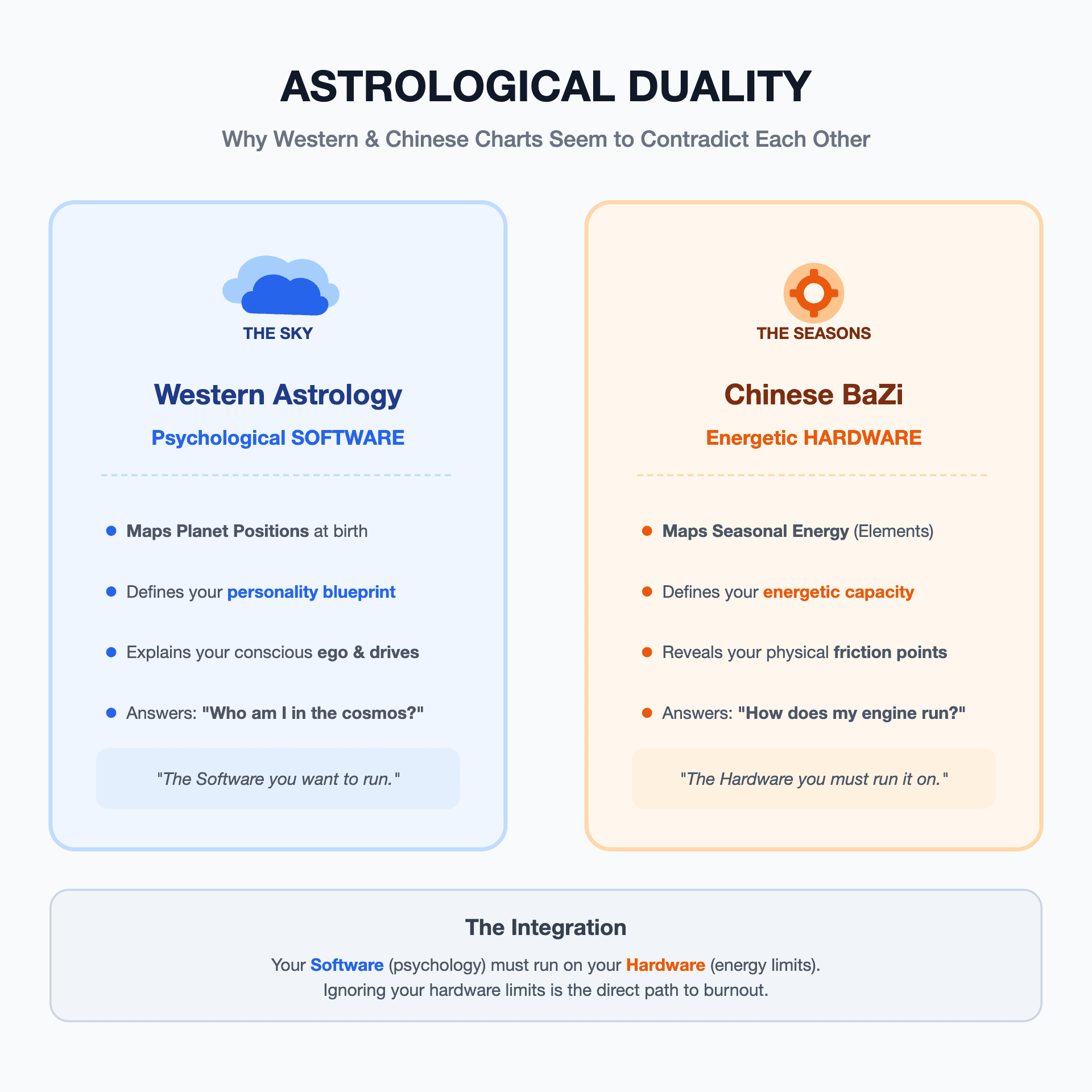
To bridge this gap, I developed a simple framework: Western astrology is your psychological Software, and Chinese astrology (BaZi) is your energetic Hardware.
The 30-Second Breakdown
- ●Western Astrology (based on constellations) represents your psychological software: your conscious desires, ego, and how you perceive yourself.
- ●Chinese BaZi (based on solar seasons) represents your energetic hardware: your physical capacity, metabolic engine, and how you sustain energy without burning out.
- ●Most burnout occurs when your "software" (e.g., an impulsive Aries Sun) tries to run on incompatible "hardware" (e.g., a slow, cautious Yin Water Day Master).
Core Metaphysics Concepts Explained
- ●Western Astrology (Software): A psychological framework based on the position of celestial bodies. It dictates your conscious drives, emotional landscape, and psychological archetypes.
- ●Chinese BaZi (Hardware): An energetic framework based on the solar season, day, and hour of birth. It calculates the elemental temperature of the earth to reveal your physical engine and metabolic capacity.
- ●Day Master: In BaZi, the Day Master is the core element defining your fundamental energetic hardware and baseline capacity.
🔭 Western Astrology = Your SOFTWARE (The Sky)
Western astrology maps where the Sun, Moon, and planets sat in the constellations at the exact minute you were born.
Because it is based on the positions of celestial bodies in relation to your perspective from Earth, it is deeply focused on the psyche. It excels at explaining:
- ●Your ego and conscious drives (your Sun sign).
- ●Your emotional landscape and subconscious needs (your Moon sign).
- ●Your psychological archetypes and how you perceive yourself.
Think of it as asking: "Who am I in relation to the cosmos?" It is the operating software you want to run. It represents your dreams, your conscious personality, and the mental interface you use to navigate the world.
⏱️ Chinese Astrology (BaZi) = Your HARDWARE (The Seasons)
Chinese astrology, or BaZi (The Four Pillars of Destiny), doesn't look at the planets. Instead, it maps the exact solar season, day, and hour you were born to calculate the elemental "temperature" of the earth at that moment.
It breaks your birth data down into the Five Elements (Wood, Fire, Earth, Metal, Water) and Ten Gods (life roles). It excels at explaining:
- ●Your energy engine and raw capacity.
- ●Your friction points and where you naturally leak energy.
- ●What drains or fuels you on a metabolic and somatic level.
- ●How you sustainably meet your environment without burning out.
Think of it as asking: "How does my physical and energetic engine actually run?" It is your internal hardware—the battery, the CPU, and the cooling system.
When the Software Mismatches the Hardware
When you run software that is too demanding for your hardware, your computer lags, overheats, and eventually crashes. The exact same thing happens to human beings.
Here are two common patterns of software-hardware mismatches that I see constantly:
1. The "Lazy" Aries
- ●The Software (Western): Aries Sun. Your mind wants to charge ahead, initiate new projects, and move fast. You are impatient and thrive on momentum.
- ●The Hardware (Chinese): Yin Water on Earth (such as an Ox branch). Your energetic engine is cold, slow, highly cautious, and tends to dam up momentum.
- ●The Result: Your mind is full of brilliant, high-velocity ideas, but your physical body freezes when it’s time to take action. You end up feeling stuck and guilty, labeling yourself as "lazy." In reality, it’s not laziness—your fast Aries software is simply clashing with your slow, cautious Yin Water hardware.
2. The "Burnout" Taurus
- ●The Software (Western): Taurus Sun. You value comfort, stability, slow rhythms, and quiet relaxation. You believe you are a chill, grounded person.
- ●The Hardware (Chinese): Yang Fire sitting on Wood. In BaZi, Wood endlessly feeds Fire. Your internal engine is running hot 24/7.
- ●The Result: You cannot turn your brain off. Despite your Taurus desire to relax on the couch, you build up a quiet, wired internal tension that eventually erupts into severe burnout. Your software thinks you are chill, but your hardware is running a constant, high-heat inferno.
Case Study: Leo’s Contradictory Elements
To show how this plays out in real life, let’s look at a sanitized case study from our early BaziLens interactions.
A user we'll call "Leo" reached out to me, deeply confused. In Western astrology, Leo is a Scorpio Sun. They felt deeply connected to the intense, watery, and emotional nature of Scorpio.
However, when they ran their BaZi chart, it revealed that their Day Master was Ji Earth (Yin Earth), and their chart was overwhelmingly dominated by Earth elements (58.5%), representing the Supporter role (specifically the Collaborator and Competitor stars). Meanwhile, their Water and Fire elements were almost non-existent (1.2% and 8.5% respectively).
Leo asked me, "How can I be a Scorpio if my actual element chart has almost no Water? Am I living a lie?"
I explained to Leo that their Scorpio Sun was their psychological software. It explained their intense desire for emotional depth, privacy, and investigative thinking. But their Ji Earth Day Master with 58.5% Earth was their hardware.
An Earth-dominated hardware means Leo possesses an incredibly strong, stubborn, and self-reliant energetic center of gravity. However, because Earth destroys Water, their massive Earth engine was actively suffocating their tiny 1.2% Water resource.
If Leo tried to live purely in their Scorpio software—constantly seeking deep emotional validation and overthinking their relationships—their massive Earth engine would collapse inward. Without an outlet, they would feel completely stuck in their own head.
To patch this bug, Leo needed to stop searching for more "Water" (emotional validation) and instead introduce Metal (The Creator) into their daily routine. Metal is the element that Earth produces, acting as an exhaust valve for heavy Earth energy. By writing, building, and creating tangible projects, Leo was able to vent their excess Earth energy, allowing their Scorpio psychological software to run smoothly without overheating their system.
How to Integrate Your Chart's Software and Hardware
When you understand both systems, you stop fighting yourself. You realize that your limitations aren't failures; they are simply the physical specs of your hardware.
Here is how you can begin integrating your two charts today:
- Identify the Mismatch: Find your Sun sign (Western) and your Day Master (Chinese). Look at your overall elemental balance. Are you running "hot" software (like Leo or Aries) on "cold" hardware (like Earth or Water)?
- Respect the Battery Limit: If your BaZi chart indicates you are low on Wood or Fire (weak vitality/output), accept that you cannot pull 80-hour workweeks, even if your Capricorn Sun software demands it. You must build in recovery cycles.
- Deploy the Right Coolant: In BaZi, if your engine is overheating (too much Fire), don't just try to "think" yourself calm. Introduce physical habits that ground you—such as structural routines (Earth) or swimming and rest (Water)—to physically cool the hardware down.
The Founder's Perspective
As the creator of BaziLens, my goal has never been to tell people their fortunes. Fortune-telling implies that you are a passive passenger in your own life.
Instead, I view these ancient systems as an operating manual. By mapping the abstract elements of Chinese metaphysics to practical psychology and system dynamics, we can treat our energy imbalances like software bugs.
You don't need to choose between Western and Chinese astrology. One tells you what program you want to run; the other tells you the physical limits of the machine you are running it on.
When you align the software with the hardware, the friction stops. You stop burning out, and you start building a life that actually fits your code.
Frequently Asked Questions
Why does my Western astrology sign contradict my Chinese BaZi chart?
Your Western sign dictates your psychological software (what your ego wants), while your BaZi chart dictates your energetic hardware (what your physical body can actually sustain).
When they contradict, it means your conscious desires are out of sync with your physical capacity. For example, a fast-moving Aries mind trapped in a slow Yin Water body will experience intense internal friction.
How do I fix the mismatch between my Western and Chinese charts?
You must prioritize your hardware (BaZi) over your software. If your BaZi chart lacks the physical vitality to sustain 80-hour workweeks, you must build in recovery cycles, regardless of what your ambitious Capricorn Sun software demands.
Physical alignment (balancing the Five Elements) always supersedes psychological willpower.
Your Next Steps
Are you exhausted from running high-velocity software on low-capacity hardware? If you feel a massive disconnect between who you think you are and what your body can actually execute, it is time to map your elemental engine. Stop guessing and start debugging. Run your data through BaziLens to align your psychological software with your energetic hardware today.
Written by Thomas | Published: June 19, 2026
Related Insights
The Burnout Equation: Why Your BaZi Explains Your Current Exhaustion (And How to Fix It)
Discover why career burnout isn't a flaw in your work ethic, but a structural friction between your Core Engine (Day Master) and your 10-Year Luck Pillar.
Why High-Performers Burn Out: The Career Friction Between Output and Officer Energies
Discover why some high-performers feel hollow in corporate jobs. A deep dive into the BaZi dynamics of 'Output' energy versus strict 'Officer' structures.
The “Tai Sui” Myth: Why Your Zodiac Year Is Not Actually Cursed
Discover why your Chinese Zodiac year (Tai Sui) isn't a curse of bad luck, but rather an extreme amplification of your personal energy ecosystem.
Discussion
0No insights shared yet. Be the first to start the discussion!