The Zodiac Interaction: Is Your 'Shallow Root' a Buff or a Bug to Your Core Engine?
Published on July 2, 2026•7 min read
The Facade vs. The Engine
We have all been asked the question: "What is your Chinese Zodiac sign?" It is the most common gateway into Eastern astrology. But if you have been following the BaziLens framework, you already know that your Zodiac sign (determined by your birth year) is just the Shallowest Root of your chart—the external shell that the public first interacts with.
Your true inner identity, the core of who you are, is your Day Master (determined by your birth day).
But these two parts of your chart do not exist in isolation. In the system architecture of a person, the way your public facade (Zodiac/Shallow Root) interacts with your true self (Day Master) creates a constant energetic feedback loop. Depending on the elemental physics of your chart, this relationship will act as either a System Buff that makes life feel effortless, or a System Bug that leads to chronic burnout or self-sabotage.
Let's look under the hood of these interactions and learn how to debug them.
The Physics of Elemental Interaction
In BaZi, everything operates on the interactions of five core elements: Wood, Fire, Earth, Metal, and Water. The relationship between your Year Pillar (Zodiac animal's base element) and your Day Pillar (Day Master's element) falls into one of four primary systemic configurations.
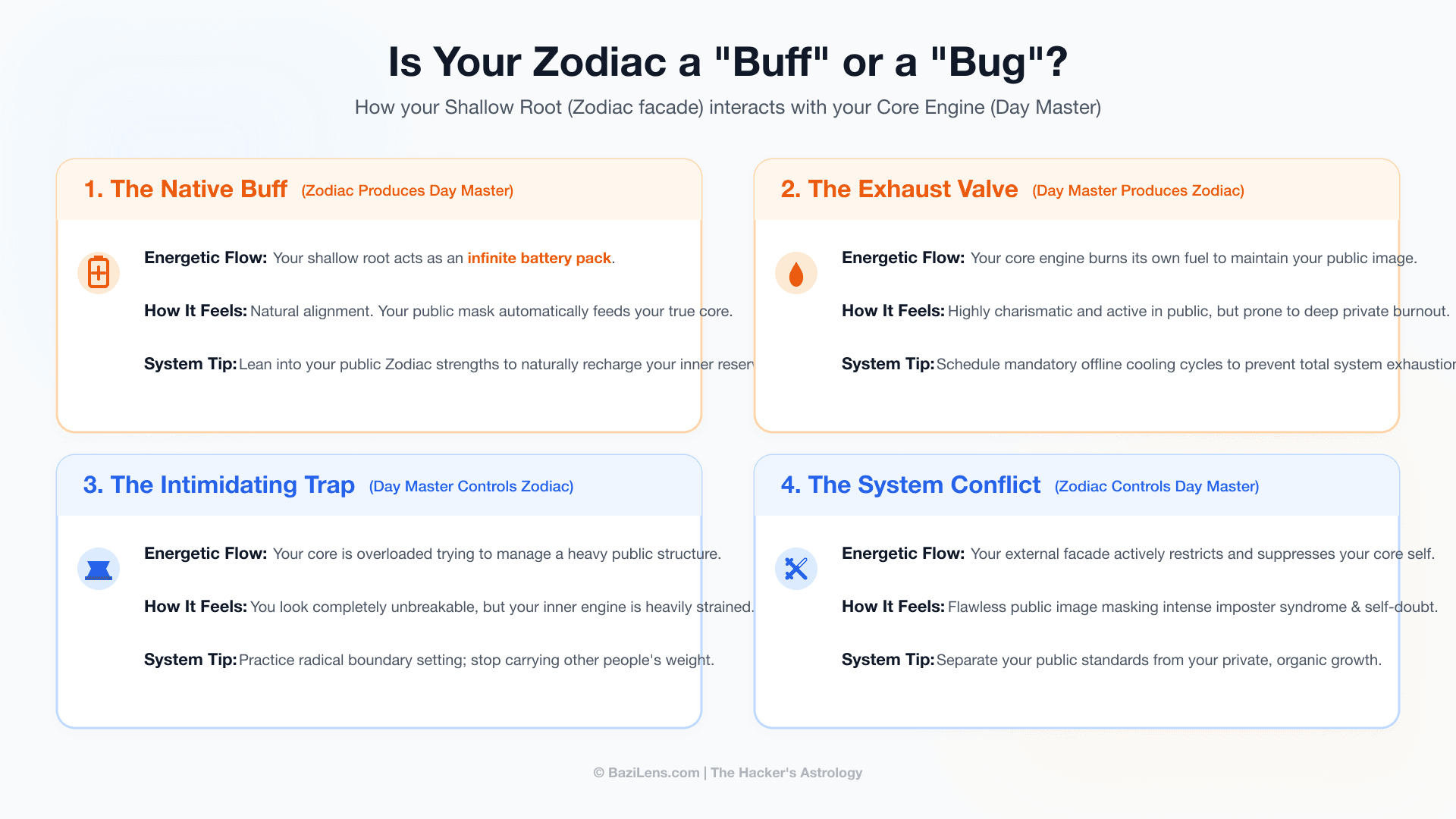
1. The Native Buff (Resource Tank)
The Native Buff occurs when the element of your Zodiac animal produces the element of your Day Master (e.g., a Wood Day Master born in a Water Pig year, or a Fire Day Master born in a Wood Tiger year).
- ●Systemic Function: Your shallow root acts as an infinite battery pack.
- ●The User Experience: You have a natural energetic buffer. The public persona you project to the world—perhaps the easygoing, deep nature of Water—naturally feeds and supports your core engine (the growth-oriented Wood). You rarely feel like you are "faking" your public facade because the energy you output into the world naturally loops back to sustain your true self.
2. The Exhaust Valve (Output Engine)
The Exhaust Valve occurs when your Day Master produces the element of your Zodiac animal (e.g., a Wood Day Master born in a Fire Horse year, or a Water Day Master born in a Wood Tiger year).
- ●Systemic Function: Your core engine is constantly burning its own fuel to maintain your public image.
- ●The User Experience: You are highly expressive, charismatic, and active in public. Your inner drive (Wood) is actively feeding the blazing output (Fire) that the world sees. The danger here is systemic depletion. If you do not install deliberate cooling cycles, your public output will evaporate your inner reserves, leaving you feeling profoundly empty and exhausted when you are alone.
3. The Intimidating Trap (The Overload)
The Intimidating Trap occurs when your Day Master controls the element of your Zodiac animal (e.g., a Wood Day Master born in an Earth Dragon/Ox/Goat/Dog year).
- ●Systemic Function: Your core engine is constantly spending energy trying to organize, manage, and conquer your public environment.
- ●The User Experience: Because Earth represents stability and wealth in this configuration, you look incredibly solid, reliable, and unbreakable to the outside world. People naturally dump responsibilities on you. However, your inner core is running hot, desperately trying to hold that heavy structure together. The constant pressure to look "strong" eventually stalls your engine.
4. The System Conflict (Self-Sabotage)
The System Conflict occurs when the element of your Zodiac animal controls (attacks) your Day Master (e.g., a Wood Day Master born in a Metal Rooster/Monkey year, or a Fire Day Master born in a Water Rat/Pig year).
- ●Systemic Function: Your public facade actively suppresses and restricts your inner core.
- ●The User Experience: This is the configuration most prone to imposter syndrome and perfectionism. You project an image of sharp, flawless execution (Metal), but internally, your core is a Wood tree that just wants to grow organically and make mistakes. Your public mask is constantly chopping down your true self before it can develop, leading to severe self-criticism.
Real-World Examples
Let's look at how these dynamics play out in actual human systems, drawn from observations using the BaziLens framework.
Case Study A: The Burnout Loop (The Exhaust Valve)
A creator named Mei came to us with severe chronic fatigue. Her Day Master was Yang Wood (a tall, ambitious tree), but she was born in a Fire Horse year.
Mei’s public brand was incredibly bright, highly expressive, and charismatic. She was the classic Horse—passionate and fast-moving. However, because Wood produces Fire, her core engine was constantly exhausting itself to feed that bright public image.
She was caught in the Exhaust Valve loop. When we analyzed her system, we realized she was treats her public persona as her primary self, forgetting that the "Horse" was just the outer root. The fix was systemic: we advised Mei to reduce her public-facing commitments, build "no-screen" containment zones, and deliberately cultivate Yin Water activities (rest, deep research, solitude) to nourish her Wood core.
Case Study B: The Perfectionist Bug (The System Conflict)
An engineer named Alex was struggling with extreme imposter syndrome, despite having a stellar career. His Day Master was Yin Wood (flexible, artistic grass), but he was born in a Metal Rooster year.
Metal cuts Wood. Alex’s public persona (Rooster) was sharp, highly organized, rule-bound, and flawless. But his inner self (Yin Wood) felt suffocated by this rigid structure.
He was running a System Conflict. Every time he tried to express his natural, creative, and organic ideas, his inner "Rooster" would criticize him, telling him it wasn't perfect enough. By identifying this conflict, Alex was able to separate the "Rooster" mask from his core. He realized his public standards were a tool he could switch off, allowing his inner Wood engine the freedom to iterate, fail, and grow in private.
How to Debug Your Own System
You do not need to be a professional astrologer to identify these loops. You can map your system with two simple data points:
- Identify your Day Master's element: This is your core engine.
- Identify your Zodiac animal's element: This is your shallowest root. Every zodiac animal has a fixed elemental base:
- ●Water: Rat, Pig
- ●Wood: Tiger, Rabbit
- ●Fire: Snake, Horse
- ●Metal: Monkey, Rooster
- ●Earth: Dragon, Dog, Ox, Goat
Once you have both elements, look at how they interact:
- ●Does your Zodiac produce your Day Master? You have a Native Buff. Recharge by leaning into your public strengths.
- ●Does your Day Master produce your Zodiac? You have an Exhaust Valve. Prevent burnout by scheduling mandatory offline cycles.
- ●Does your Day Master control your Zodiac? You have an Intimidating Trap. Delegate responsibilities and stop trying to carry the world.
- ●Does your Zodiac control your Day Master? You have a System Conflict. Practice self-compassion and separate your public expectations from your private growth.
(Note: If your Zodiac element and your Day Master are the exact same element—e.g., a Wood Day Master born in a Wood Tiger year—you have a Companion relationship. This creates a highly collaborative but competitive dynamic, which we outline in detail in our full reports.)
If you are ready to stop guessing and start debugging your system, let's run a full diagnostic.
Related Insights
The Burnout Equation: Why Your BaZi Explains Your Current Exhaustion (And How to Fix It)
Discover why career burnout isn't a flaw in your work ethic, but a structural friction between your Core Engine (Day Master) and your 10-Year Luck Pillar.
Why High-Performers Burn Out: The Career Friction Between Output and Officer Energies
Discover why some high-performers feel hollow in corporate jobs. A deep dive into the BaZi dynamics of 'Output' energy versus strict 'Officer' structures.
The “Tai Sui” Myth: Why Your Zodiac Year Is Not Actually Cursed
Discover why your Chinese Zodiac year (Tai Sui) isn't a curse of bad luck, but rather an extreme amplification of your personal energy ecosystem.
Discussion
0No insights shared yet. Be the first to start the discussion!